
Strategy · How-To
Affiliate Niche Sites in 2026: What Works, What Doesn't & How to Build One
By Grant Ongstad · 17 min read · Rates as of September 24, 2026
Affiliate niche sites are not dead.
But the version of them that dominated SEO ten years ago is getting harder to justify.
- Find a low-competition niche.
- Buy an exact-match domain.
- Publish 100 articles.
- Add Amazon links.
- Build some backlinks.
- Wait for Google.
That was the playbook. And for a long time, it worked surprisingly well.
In 2026, I would build an affiliate niche site very differently.
I would still use SEO. I would still research keywords. I would still publish commercial content targeting people who are close to buying something.
But I would not build a business where the entire strategy depends on Google ranking 100 articles written from information anyone else could find online.
The better model looks more like this:
That distinction matters. Because affiliate niche sites can still be fantastic businesses. They just need a reason to exist.
What Is an Affiliate Niche Site?
An affiliate niche site is a website focused on a specific market, audience, hobby, problem, or product category that makes money by referring visitors to other companies.
When someone clicks an affiliate link and makes a qualifying purchase, the website earns a commission.
For example, instead of building a broad website about fitness, you could build a site about:
- Compact home gyms
- Garage gym equipment
- Adjustable dumbbells
- Strength training for busy dads
- Home gyms for small spaces
Instead of building a broad pet website, you might focus on:
- Senior dog products
- Hiking gear for dogs
- Indoor cat enrichment
- Large-breed dog equipment
- Traveling with pets
The niche gives the website focus. The affiliate model gives it a way to make money.
But a niche site does not have to be a tiny website. Some eventually grow into large media companies, communities, tools, newsletters, or ecommerce brands.
The important part is that the site begins by serving a specific group of people better than a general publication can.
The Old Affiliate Niche Site Model
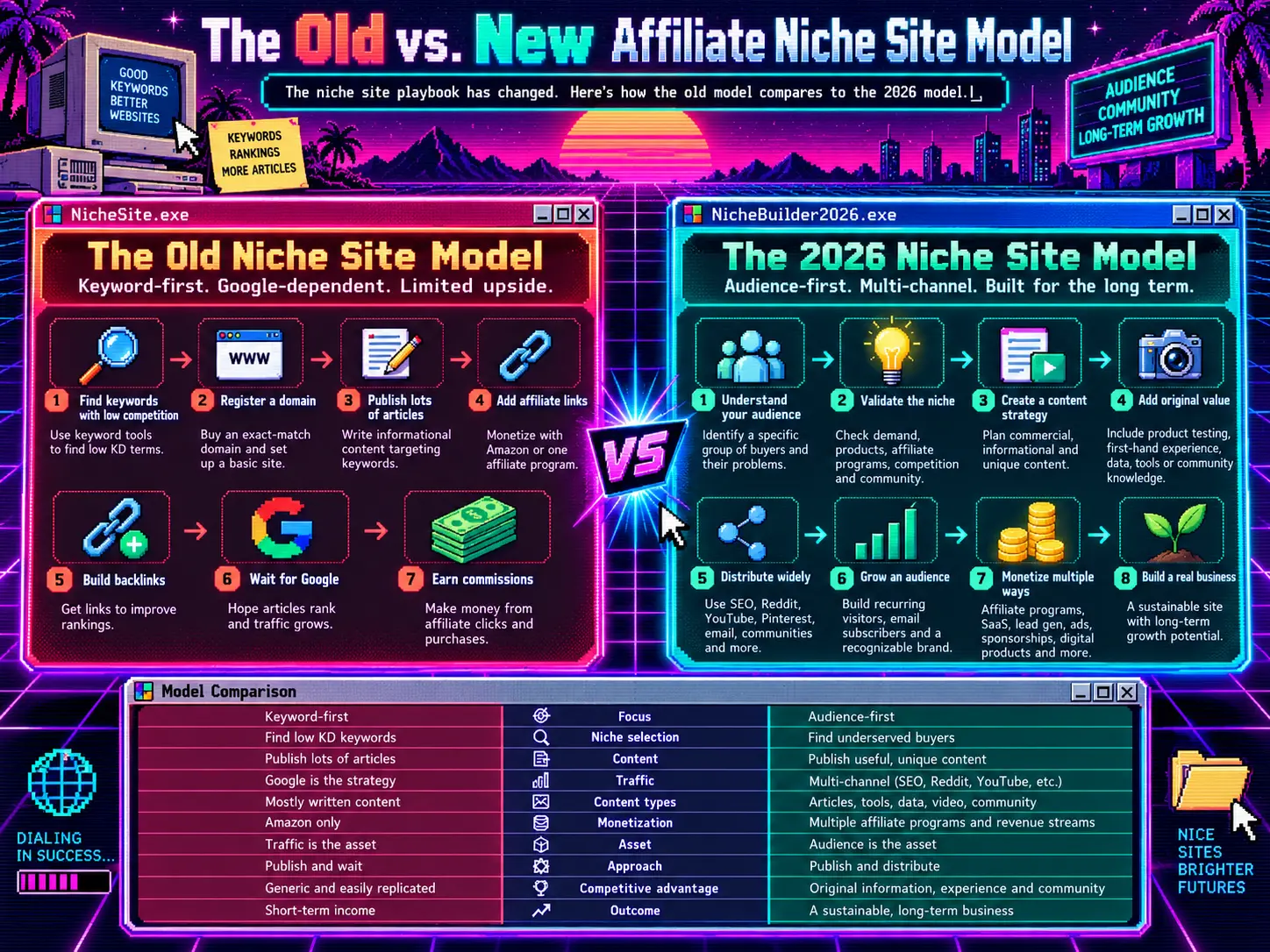
The old niche-site formula was heavily dependent on Google. It looked something like this:
- Find keywords with low competition.
- Register a domain.
- Publish informational articles.
- Publish "best" product roundups.
- Add affiliate links.
- Build backlinks.
- Wait for traffic.
- Repeat.
You could find someone ranking for "best camping coffee maker," rewrite the same recommendations into a longer article, add a comparison table, and sometimes outrank them.
There were entire businesses built around doing this at scale.
The actual audience barely mattered. Distribution barely mattered. You didn't necessarily need products of your own. You didn't need an email list. You didn't need people to know your brand. In some cases, you didn't even need particularly deep expertise.
You needed rankings. That model is much less attractive today.
Why the Affiliate Niche Site Model Changed
The biggest change isn't that SEO stopped working. It didn't.
Google continues to say that traditional SEO fundamentals still matter for Search, including AI-powered search experiences.
But Google is also increasingly emphasizing content that provides original value rather than simply reproducing information already available elsewhere.
That's the part niche-site builders should pay attention to.
Publishing became cheap. Information became cheap. Anyone can generate a competent 2,000-word article about adjustable dumbbells, espresso machines, or RV batteries in minutes.
That means "we wrote an article about it" isn't much of an advantage anymore.
Google's people-first content guidance asks publishers whether their content contains original information, reporting, research, or analysis and whether it demonstrates first-hand expertise.
Google's spam policies also target scaled content created primarily to manipulate rankings when that content provides little additional value.
Sources:
So the question has changed. It used to be: Can I rank for this keyword?
Now niche builders should also ask: Can I build the best resource for this audience?
Those aren't the same question.
Are Affiliate Niche Sites Still Profitable in 2026?
Yes. But "affiliate niche sites" describes a business model, not a guaranteed outcome.
There are still publishers building traffic and earning commissions from organic search. There are also publishers reporting dramatically worse economics than they experienced several years ago.
The takeaway isn't "SEO is dead." It's: SEO-only is a bigger business risk.
That's a major distinction.
A niche website that gets traffic from Google, Reddit, Pinterest, YouTube, Facebook groups, email, direct visitors, and other communities is fundamentally different from one where almost all revenue disappears if Google changes a few ranking positions.
I still want Google traffic. I just don't want Google to be the entire business.
The Old Model vs. the 2026 Affiliate Site
| Old Niche-Site Model | 2026 Niche-Site Model |
|---|---|
| Start with keywords | Start with an audience |
| Find low keyword difficulty | Find weak markets and underserved buyers |
| Publish lots of articles | Publish things worth finding |
| Rewrite existing SERPs | Add original information |
| Google is the traffic strategy | Google is one traffic channel |
| Mostly written content | Content, data, tools, video, community |
| Amazon first | Multiple affiliate relationships |
| Traffic is the asset | Audience is the asset |
| "Best X" roundups | Help people make actual decisions |
| Build backlinks later | Create things people naturally reference |
| Publish then wait | Publish and distribute |
That's the affiliate niche site I would build today.
Start With a Buyer, Not a Keyword
This is probably the biggest change I would make. A keyword isn't a niche.
"Adjustable dumbbells" is a keyword. "Home strength training equipment for dads with small garages" is much closer to a niche.
Now I know something about the person. They have limited space. They're probably buying equipment. They care about storage. They may compare racks, benches, dumbbells, flooring, and other equipment. They may eventually upgrade. They probably hang out in home gym communities.
You can build around that. A good niche usually looks something like:
For example:
- Coffee + home enthusiasts + making café-quality espresso
- Garage storage + homeowners + still parking cars inside
- Travel + families + traveling with toddlers
- Pet care + senior dog owners + mobility
- Golf + homeowners + building simulators
The market already exists. You're not trying to invent demand. You're finding a version of the market that isn't being served particularly well.
Validate the Niche Before Building Anything
One of the most expensive mistakes in affiliate marketing is discovering six months into a project that the niche wasn't very good.
Before I buy a domain, I want evidence. At minimum, I want to know:
Are People Searching for It?
Not one giant keyword. I want an ecosystem of searches: commercial searches, questions, comparisons, problems, product categories, alternatives. Queries like:
- Best X for Y
- X vs. Y
- Is X worth it?
- X under $500
- X for small spaces
- X alternatives
That's healthier than finding one keyword with impressive search volume.
Can I Identify Dozens of Useful Topics?
I generally want to see at least 30 to 50 legitimate content opportunities before getting excited. Not 50 variations of the same article. Actual questions and decisions.
If you struggle after ten ideas, you might not have a standalone niche.
Do People Spend Money Here?
This sounds obvious, but affiliate builders sometimes confuse traffic with a market. I want products, services, software, accessories, upgrades, subscriptions, replacement purchases, high-ticket purchases, recurring purchases. Ideally several of those.
Are There Good Affiliate Programs?
Amazon can be useful. It shouldn't automatically be the entire monetization strategy. Look for:
- Direct brand programs
- Affiliate networks
- SaaS programs
- Marketplaces
- High-ticket offers
- Recurring commissions
- Lead generation
- Sponsorship opportunities
Two sites with identical traffic can have dramatically different economics depending on what happens after someone clicks.
Can a Smaller Site Compete?
Actually look at the SERPs. Don't stop at a keyword difficulty score. Ask:
- Are smaller specialist websites ranking?
- Are Reddit and forums appearing?
- Are old articles ranking?
- Are results targeting the keyword indirectly?
- Are publishers answering the wrong intent?
- Are giant brands ranking simply because nobody has created something better?
Those are signals worth investigating.
Read our deeper guide: How to Validate a Niche Website Idea
Find the Angle Before You Find the Domain
I would not build CoffeeGearGuide.com just because I decided coffee products have good affiliate programs.
I'd ask what I can own inside coffee. Maybe: espresso setups for people with small kitchens.
Now we're getting somewhere. You can cover:
- Narrow espresso machines
- Compact grinders
- Coffee carts
- Under-cabinet setups
- Storage
- Knock boxes
- Small scales
- Machine dimensions
- Water solutions
- Accessories
- Workflow layouts
- Setup photos
That's an actual editorial point of view.
Broad markets can still produce fantastic niche opportunities when you slice them by audience, constraint, problem, use case, budget, or experience level.
The goal isn't to find a niche nobody has heard of. The goal is to find a group of people who deserve a better resource.
Your Site Needs Something AI Can't Reproduce in 30 Seconds
Ask yourself: What will exist on my website that didn't exist on the internet before I created it?
That could be:
Original Testing
Buy the products. Use them. Measure them. Photograph them. Break them. Compare them.
Original Data
Build a database. Track prices. Compile specifications. Survey users. Analyze reviews. Collect information scattered across dozens of manufacturers.
Tools
Build calculators, configurators, compatibility checkers, quizzes, databases, search tools, and comparison engines. Tools can become a serious moat.
First-Hand Experience
There is still an enormous difference between "Here are seven products we found online" and "We installed all seven of these in a one-car garage and measured how much floor space each one actually saved."
That's the content I want to make.
Community Knowledge
A strong niche site can become a place where people contribute knowledge instead of simply consuming articles. That could mean user reviews, comments, forums, Q&A, surveys, reader setups, member recommendations, or community data.
Now the site becomes harder to clone.
Stop Thinking Only in Terms of Articles
One of the most useful affiliate websites to study is PCPartPicker.
Its real advantage isn't having more blog posts about computer components. It built something useful. The compatibility system gives people a reason to visit the website directly.
That's a fundamentally stronger position than publishing another "10 Best Graphics Cards" article.
The same principle can apply to much smaller niches:
| Site | Useful tool |
|---|---|
| Home gym site | Equipment database sorted by ceiling height |
| RV site | Solar calculator based on appliances and battery capacity |
| Espresso site | Grinder compatibility and machine-dimension database |
| Garage site | Storage planner based on garage dimensions |
| Golf site | Simulator room-size calculator |
| Pet site | Product finder based on breed, weight, and condition |
You don't need to build the next PCPartPicker. You just need to ask: What would genuinely help this audience make a decision?
You Still Need Commercial Content
None of this means abandoning buying guides. Affiliate sites need buyers. Commercial searches are still extremely valuable. Look for queries like:
- Best X for Y
- X vs. Y
- X review
- Best X under $500
- Best X for beginners
- X alternatives
- Is X worth it?
- Cheapest X
- Premium X
- X for small spaces
- X for professionals
- X for apartments
- X for families
The difference is how you create those pages.
Don't write "10 Best Espresso Grinders" because a keyword tool says it gets traffic.
Create "7 Best Espresso Grinders for Small Kitchens: We Compared Footprint, Noise and Workflow."
Now there is a reason for the article to exist. Specificity is one of the easiest ways for a smaller publisher to compete with broad websites.
Informational Content Still Matters
Commercial content makes money. Informational content builds the world around it.
Suppose you run an affiliate site about garage gyms. Commercial content might include:
- Best short power racks
- Best adjustable dumbbells
- Best folding squat racks
- REP vs. Rogue
- Best benches for small garages
Informational content could include:
- Minimum ceiling height for a power rack
- How much space you need around a squat rack
- How to protect garage floors
- Can you lift in an unheated garage?
- How to prevent equipment rust
- How to organize plates in a one-car garage
Those articles attract people earlier. They establish expertise. They create internal-linking opportunities. And some can become far more useful than product roundups.
Build Distribution Into the Niche From Day One
Before building a niche site, answer: Where do these people already spend time?
Look for Reddit, Facebook groups, YouTube, Pinterest, X, LinkedIn, forums, Discord, newsletters, trade publications, associations, podcasts, and local communities.
Not every niche needs all of them. But you want options.
Your site might take months to gain meaningful Google visibility. A useful Reddit post can generate visitors today. A Pinterest pin can start circulating. A YouTube tutorial can rank. An email list can bring someone back. A Facebook group can teach you what people are struggling with.
Community participation also makes your content better because you hear how real buyers describe their problems.
Distribution isn't something you figure out after publishing. It's part of niche research.
One Article Should Become More Than One Article
Let's say you publish "7 Best Storage Systems for a One-Car Garage." That could become:
- Reddit: "I tested seven ways to add storage without losing your parking space. Here's what actually worked."
- YouTube: A visual before-and-after comparison.
- Pinterest: Garage layout diagrams.
- X: Seven mistakes people make when organizing a small garage.
- Facebook Groups: A discussion about wall storage vs. overhead storage.
- Email: Three upgrades I'd make first in a cramped garage.
One piece of research creates multiple ways for people to discover you.
That is a completely different mindset from publishing an article and checking Search Console every morning.
Don't Depend on One Affiliate Program
The same diversification principle applies to revenue.
Imagine your whole site depends on one merchant. They cut the commission rate. They remove their program. They change attribution. Your account gets closed.
Your traffic hasn't changed, but your business has.
Before I build a niche site, I like to see multiple possible revenue paths:
- Physical products: Amazon, brand-direct programs, retailers, specialty stores
- Software: recurring SaaS commissions, flat referral payouts, reseller agreements
- Leads: local service providers, education, insurance, home improvement, professional services
- Later-stage monetization: advertising, newsletter sponsorships, digital products, paid directories, memberships, courses, your own products
Affiliate marketing can be the starting model without being the final model.
Customer Value Matters More Than Most Beginners Realize
Imagine two websites each receive 5,000 visitors per month. Site A covers $20 kitchen gadgets. Site B covers $2,500 garage storage systems.
They have the same traffic. They do not necessarily have remotely similar business potential.
That doesn't mean expensive products are always better. Competition may be harder. Conversion rates may be lower. Buying cycles may be longer.
But you need to understand what a visitor can actually be worth. Sometimes improving monetization is a bigger opportunity than doubling traffic.
Read more: What Niche Sells the Most?
Use AI Aggressively, But Don't Outsource the Strategy
I use AI. A lot. I think niche builders should. Use it for:
- Organizing research
- Clustering keywords
- Analyzing SERPs
- Brainstorming angles
- Building content briefs
- Editing
- Extracting comparison points
- Finding internal-link opportunities
- Repurposing content
- Structuring research
- Generating questions
But I wouldn't tell AI "Write 200 articles about camping" and call that a content strategy.
Publishing is no longer the expensive part. Judgment is.
Which niche? Which audience? Which keyword? Which angle? Which product? Which article deserves to exist? Which distribution channel? What should you test yourself? What information can you add that nobody else has?
Those decisions become more important as content generation becomes easier.
How I Would Build an Affiliate Niche Site From Scratch
If I were starting today, this would be my process.
Step 1: Pick an Audience With Buying Behavior
Not simply a topic. Find people who repeatedly spend money solving related problems.
Step 2: Validate the Market
Look at search demand, products, affiliate programs, communities, SERPs, competitors, content depth, and customer value.
Step 3: Find Your Angle
Finish this sentence:
If you can't make it specific, keep researching.
Step 4: Find 20 to 30 Commercial Opportunities
Before building the site, find actual searches connected to buying decisions. If you can't find them, investigate why.
Step 5: Map the Supporting Information
What does someone need to understand before buying? Build around their decision process.
Step 6: Identify Your Moat
What can you test? What can you measure? What can you collect? What can you build? What can you know better than a general publisher?
Step 7: Identify Distribution
Find the communities before you need them.
Step 8: Build the Smallest Useful Version
You don't need 100 articles to launch. Publish enough to establish what the site is about and start learning.
Step 9: Watch Real Behavior
Monitor:
- Search Console queries
- Affiliate clicks
- Reddit engagement
- Email signups
- Community questions
- Pages receiving impressions
- Products people actually click
Let the market tell you where to go next.
Step 10: Double Down
Don't blindly execute a 12-month content calendar created before you had any data. Build more of what starts working.
How Narrow Should an Affiliate Niche Be?
Narrow enough to have an identity. Broad enough to have room to grow.
"Fitness" is too broad for most independent builders. "Resistance bands for women over 40" may be too narrow for an entire long-term brand. "Compact home fitness" gives you much more room.
You can begin with adjustable dumbbells, benches, folding racks, compact cardio, storage, flooring, workout programming, garage gyms, and apartment gyms — then expand as the site earns the right to.
A niche is not a prison. It's your starting position.
Should Beginners Still Build Affiliate Niche Sites?
I think they can be one of the best ways to learn online business.
You learn SEO, content, copywriting, analytics, affiliate marketing, websites, conversion, email, distribution, community building, partnerships, and research — and you can learn all of it on a small website you control.
But beginners should be realistic about the market they choose.
Highly regulated or heavily scrutinized areas like finance and health can present additional challenges for someone without relevant expertise.
A hobby or home niche where you can actually buy, test, and photograph products is often much easier to build credibility around.
Read more: Best Affiliate Niches for Beginners
So, Are Affiliate Niche Sites Dead?
No.
Lazy niche sites are struggling. Commodity information is struggling. Publishing content simply because a keyword tool told you to is a weaker strategy.
Building a website whose entire competitive advantage is "we wrote 2,500 words about the keyword" is getting harder.
But people still research products. People still compare solutions. People still search Google. People still ask Reddit. People still watch product reviews. People still need help making expensive decisions.
Affiliate marketing sits directly in the middle of that behavior.
The opportunity hasn't disappeared. The standard has changed.
The Affiliate Niche Site I Want to Own in 2026
I want a site with:
- A clearly defined audience
- Products people actually buy
- Several ways to monetize
- Commercial search demand
- Information worth publishing
- A community I can participate in
- Traffic sources beyond Google
- Real experience
- Original information
- Useful tools or resources
- An email list
- A recognizable brand
- A reason someone would choose it over the 50 sites covering the same products
That sounds harder than publishing 100 AI articles. It is.
It also sounds a lot more like a business.
The 2026 Affiliate Niche Site Formula
The old formula:
The model I would build now:
SEO is still part of it. Affiliate links are still part of it. Content is still part of it. But none of those things should exist in isolation.
At AffiliateNicheSites.com, that's the model we're building around.
We currently have research covering 40+ scored niches and 100+ tracked affiliate programs, alongside tools for keyword research, competitor research, content planning, distribution, and backlinks.
The first question isn't "How many articles should I publish?" It isn't "What's the lowest keyword difficulty?" It isn't even "What's the highest-paying affiliate program?"
Start here: What audience can I understand better than the broad websites already trying to reach them?
Find that. Then build something they would actually miss if it disappeared.
That's an affiliate niche site worth building.